
Hello.
I am Dr. Hyuk-chan Jo, Director of Cleor Clinic Uijeongbu Branch.
Have you ever experienced the urge to keep touching small bumps or moles when looking at your face closely in the mirror?
"My milia around the eyes are increasing, and I have skin tags on my neck.
I am concerned because flat warts seem to be spreading on my forehead and cheeks."
Skin surface lesions are not caused by a single factor.
UV exposure, aging, friction, sebum and keratin buildup, viral infections, and genetic factors work together,
creating an environment where different types of lesions can coexist at the same time.
A treatment line commonly used for such diverse surface lesions is the CO2 laser, which acts selectively on water molecules within human tissue.
The Uijeongbu CO2 laser is designed to precisely vaporize only the target lesions, minimizing damage to surrounding healthy tissue.
Today, I will summarize the principles of the Uijeongbu CO2 laser and how it is used for various lesions.
What is the Uijeongbu CO2 laser?
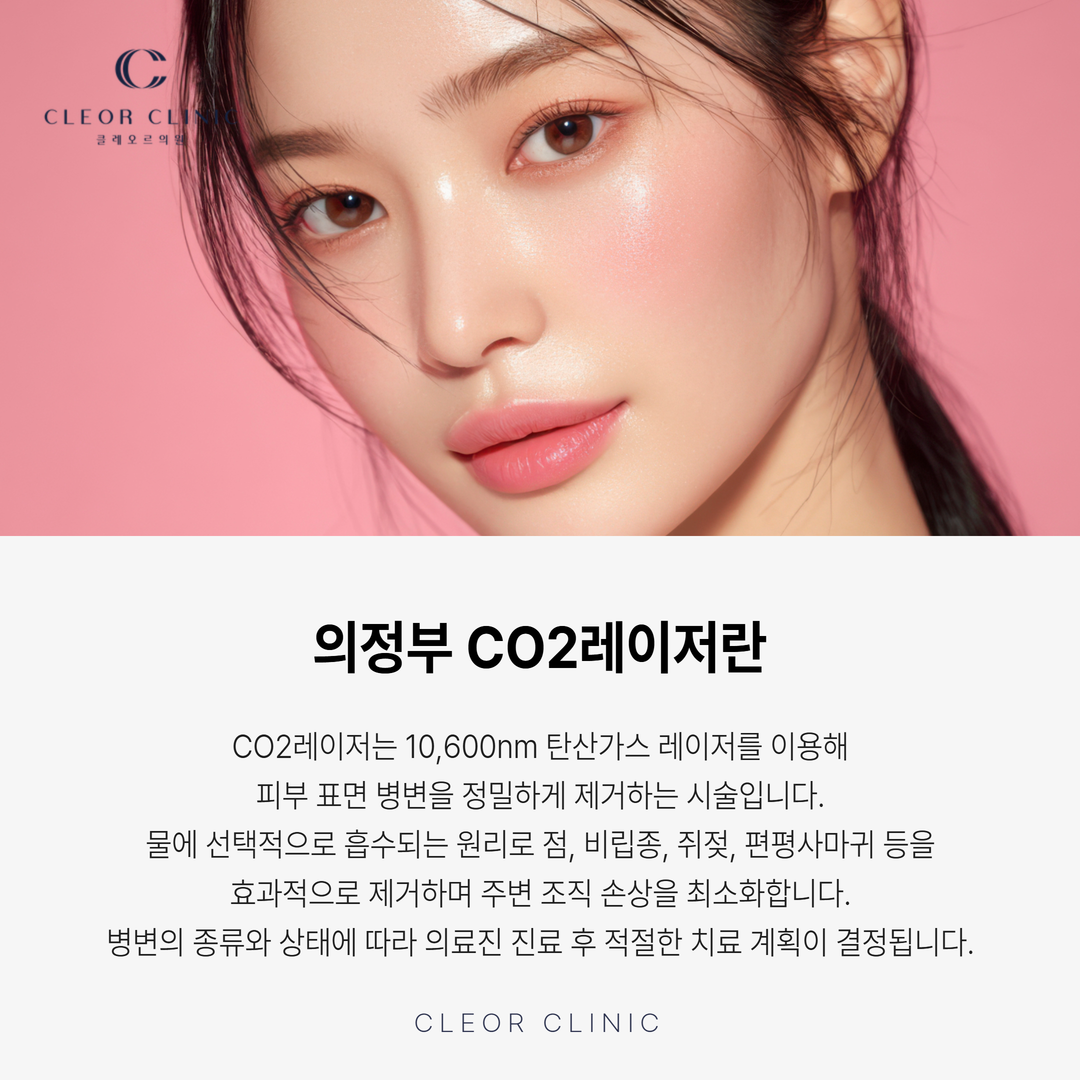
👉 The Uijeongbu CO2 laser is a 10,600nm wavelength carbon dioxide laser.
It is a procedure that precisely removes surface lesions such as moles, milia, skin tags, and flat warts by utilizing the principle of selective absorption into water molecules in human tissue.
The core of the CO2 laser is its 10,600nm infrared wavelength.
This wavelength has a very high absorption rate in water,
so when it is applied to the skin surface, the water molecules in the target area are rapidly heated,causing the tissue to vaporize immediately.Since about 70% of human skin tissue consists of water,
the CO2 laser precisely removes the targeted area while minimizing damage to the surrounding healthy tissue.
Because the same equipment can be used for various types of surface lesions,
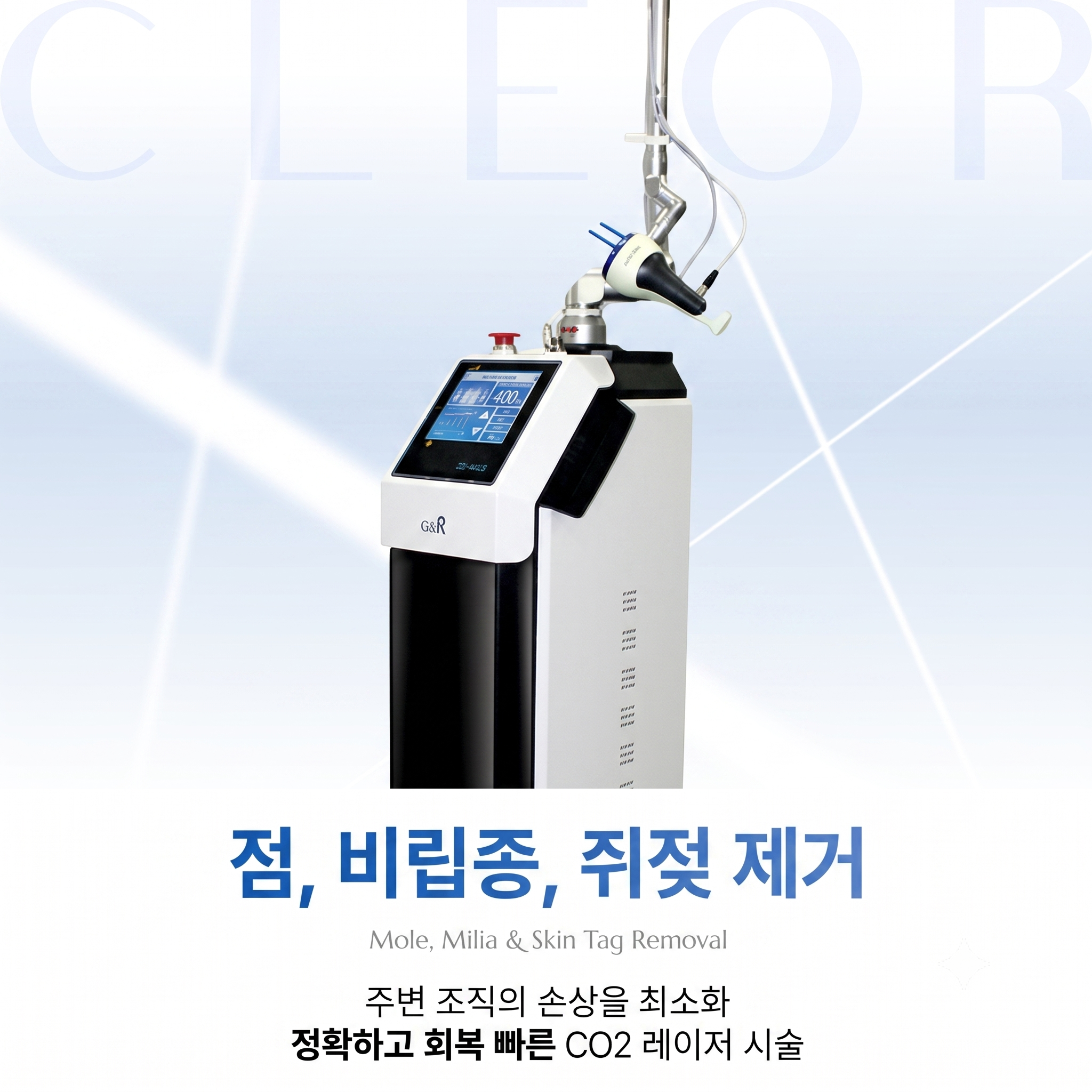
it is operated for a wide range of categories such as moles, milia, skin tags, flat warts, syringomas, and sebaceous hyperplasia.
Technical Features of Uijeongbu CO2 Laser
👉 The Uijeongbu CO2 laser is a procedure with four key features: 10,600nm wavelength, selective action on water molecules, precise removal via aiming beam, and reduced bleeding through thermal coagulation.
10,600nm Wavelength
The CO2 laser operates at a 10,600nm wavelength in the infrared range.
It has a very high absorption rate for water, so when it acts on the surface of human tissue,
it is known for a mechanism that delivers energy intensively to the target area.
Selective Action on Water Molecules
This line utilizes the fact that about 70% of skin tissue is composed of water.
When water molecules absorb laser energy, they heat up rapidly,
leading to tissue vaporization, which allows for the precise removal of only the target lesion while minimizing damage to surrounding healthy tissue.
Precise Removal via Aiming Beam
The CO2 laser uses an aiming beam to act accurately only on the lesion area.
It is classified as a line capable of delicate removal because the treatment range can be adjusted according to the size, depth, and location of the lesion.
Reduced Bleeding via Thermal Coagulation
The CO2 laser performs thermal coagulation on micro-vessels simultaneously with tissue vaporization.
This creates an environment with relatively less bleeding during the procedure,
which helps in securing a clear view during treatment and reducing the burden of recovery.
Effects and Advantages of Uijeongbu CO2 Laser
👉 The core advantages of the Uijeongbu CO2 laser are summarized as: versatility for various surface lesions, precise removal with reduced bleeding, and short treatment time.
First, it can be used for various surface lesions.
It is known as a line that can approach surface lesions in various categories such as moles, milia, skin tags, flat warts, syringomas, and sebaceous hyperplasia with the same equipment.
Second, it provides both precise removal and reduced bleeding.
Because it acts precisely on the lesion using an aiming beam while minimizing bleeding through thermal coagulation, it is reported as a procedure with a relatively low recovery burden.
Finally, it is a procedure with a short treatment time.
Although it varies depending on the number and size of the lesions, each lesion is treated in a short amount of time, allowing multiple lesions to be addressed in one session.
Lesions Treated by Uijeongbu CO2 Laser
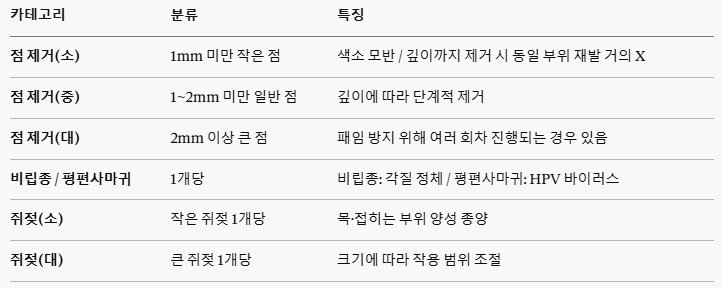
👉 The Uijeongbu CO2 laser is operated on a per-lesion basis for surface bumps like moles, milia, skin tags, and flat warts, depending on their size and type.
Since the treatment range and number of sessions vary depending on the type, number, location, and depth of the lesions,
we will discuss the appropriate treatment plan for your specific condition during a pre-treatment consultation.
Who is the Uijeongbu CO2 Laser for?
Those concerned about increasing milia around the eyes and cheeks
Those with skin tags on the neck or underarms
Those who feel flat warts are spreading on their forehead or cheeks
Those bothered by small moles or bumps that cannot be covered with makeup
Those who want to address various types of surface lesions in one session
Side Effects and Precautions for Uijeongbu CO2 Laser
👉 Although the Uijeongbu CO2 laser is a line for precise removal of surface lesions, it is good to understand in advance that the possibility of recurrence and the need for multiple sessions vary depending on the type of lesion.
Immediately after the procedure, mild redness, stinging, oozing, or scabbing may occur.
Scabs usually fall off naturally within 1 to 2 weeks,
and the area where the scab fell off will temporarily appear pinkish.
For deep-rooted moles, removing them forcefully at once can cause skin depressions,
so it is often done in stages to avoid such depressions.
In this case, re-treatment is possible after the area has fully regenerated.
Flat warts and skin tags are areas where HPV viral infection and constitutional/genetic factors work together,
so even if the lesion is removed, recurrence due to lowered immunity or constitutional factors is reported.
In particular, since invisible viruses may remain in the surrounding skin for flat warts,
recurrence can occur in nearby or other areas after one session,
and it is known that results are more stable when immune management is maintained.
Milia and syringomas can also newly appear over time due to constitutional and genetic factors.
UV protection is recommended after the procedure to reduce the possibility of post-inflammatory hyperpigmentation (PIH),
and not artificially removing the scab until it falls off naturally helps with recovery.
Please inform us in advance if any of the following apply to you:
If you are pregnant or breastfeeding
If you have active herpes or severe infection in the treatment area
If you have a keloid tendency or are prone to hypertrophic scarring
If you have recently taken photosensitizing drugs or isotretinoin
If you have recently received strong peeling or high-energy procedures in the treatment area
⚠️ Precautions Before and After Uijeongbu CO2 Laser
👉 For the Uijeongbu CO2 laser, management at each stage before and after the procedure affects recovery and the possibility of pigmentation.
❓ Frequently Asked Questions (FAQ)
Q. Is everything removed in one session with the Uijeongbu CO2 laser?
It depends on the type and depth of the lesion.
Small surface lesions are often finished in one session, but deep moles may be removed in stages over several sessions to prevent depressions, and flat warts and skin tags are categories with a possibility of recurrence due to constitutional/viral factors.
Q. Do flat warts recur after Uijeongbu CO2 laser treatment?
Since flat warts are caused by HPV (Human Papillomavirus) infection, invisible viruses may remain in the surrounding area even after the lesion is removed.
It is an area where recurrence is reported in the same or other locations if immunity is weak or irritation accumulates, so results are more stable when immune management is maintained alongside the procedure.
Q. Does the Uijeongbu CO2 laser leave scars?
Since it is a line that acts precisely only on the lesion using an aiming beam, the risk of scarring is generally low.
However, if deep lesions are forcefully removed at once, there is a possibility of depression, and if UV protection is insufficient, temporary pigmentation may occur.
Most cases are reported to fade within 1 to 3 months.
Q. How should I manage scabs after Uijeongbu CO2 laser treatment?
Scabs form while absorbing oozing immediately after the procedure,
and applying a hydrocolloid patch to maintain a moist environment is helpful for recovery.
Scabs fall off naturally within 1 to 2 weeks,
and it is recommended to wait for natural detachment as removing them artificially can increase the possibility of pigmentation or scarring.
Q. Can I wear makeup immediately after Uijeongbu CO2 laser treatment?
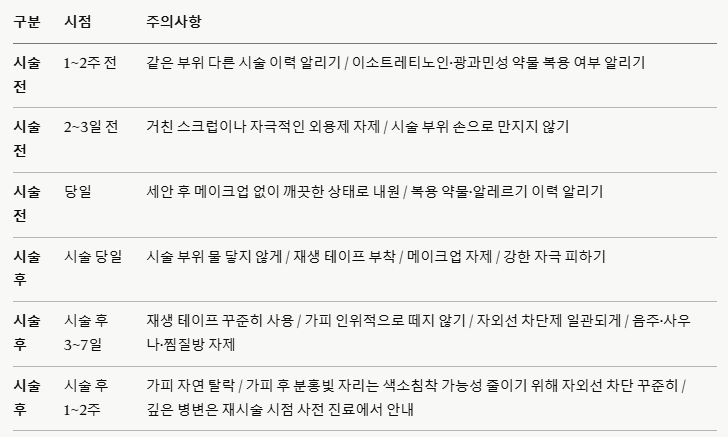
It is recommended to refrain from makeup on the day of the procedure to avoid irritating the treated area.
After the scabs have fallen off, light makeup with non-irritating products is possible, and specific timing will be guided during the pre-treatment consultation.
Q. How much pain is involved with the Uijeongbu CO2 laser?
Since the application of numbing cream before the procedure is standard, strong pain during the procedure is minimal.
The level of irritation varies depending on the size and location of the lesion, and mild stinging may accompany the area for a few days after the procedure.
Q. Can multiple lesions be removed at once with the Uijeongbu CO2 laser?
Depending on the type and number of lesions, they can be removed in one session.
However, if too many areas are treated at once, the recovery burden may increase, so the appropriate treatment plan for your skin condition and schedule will be organized during the pre-treatment consultation.
Skin surface bumps are not caused by a single factor but are multifactorial changes where UV exposure, aging, friction, keratin buildup, viral infection, and genetic factors work together, leading to different types of lesions coexisting at the same time.
This is also why a line that can be commonly used for different lesions has become established.
The Uijeongbu CO2 laser is a procedure that precisely vaporizes and removes surface bumps like moles, milia, skin tags, and flat warts based on the principle that a 10,600nm wavelength is selectively absorbed by water molecules in human tissue.
It is good to understand that for lesions where viral or constitutional factors work together, such as flat warts and skin tags, there is a possibility of recurrence even after the procedure, so results are more stable when lifestyle management such as immune care and UV protection are maintained.
We will personally check the appropriate treatment plan for your lesion type, number, location, and depth during the consultation.
If you are concerned about surface lesions such as moles, milia, skin tags, or flat warts, please feel free to visit Cleor Clinic Uijeongbu Branch.
Even before deciding on a procedure, we will provide detailed guidance on the appropriate care direction for your skin condition through a pre-treatment consultation.
※ This content is for general information purposes only, and results may vary by individual.
Please decide on accurate diagnosis and treatment through consultation with a specialist.
시술 직후 진물을 흡수하면서 가피가 형성되는데
재생 테이프를 부착해 습윤한 환경을 유지하는 게 회복에 도움이 되는 흐름이에요.
가피는 1~2주 안에 자연스럽게 떨어지는 흐름이고
인위적으로 떼면 색소침착이나 흉터 가능성이
늘어날 수 있어 자연 탈락을 기다리는 게 권해집니다.
Q. 의정부 CO2레이저 시술 후 바로 메이크업이 가능한가요?
시술 당일은 시술 부위에 자극을 주지 않기 위해 메이크업을 자제하시는 게 권해져요.
가피가 떨어진 뒤부터는 자극이 적은 제품으로 가벼운 메이크업이 가능하고
세부 시점은 사전 진료에서 함께 안내됩니다.
Q. 의정부 CO2레이저 통증은 어느 정도인가요?
시술 전 마취 크림 도포가 일반적이라 시술 중 강한 통증은 적은 편이에요.
병변 크기와 위치에 따라 자극감이 다른 영역이고,
시술 후 며칠 정도 가벼운 따끔거림이 동반될 수 있습니다.
Q. 의정부 CO2레이저 여러 병변을 한 번에 제거할 수 있나요?
병변 종류와 개수에 따라 한 일정 안에 함께 제거 가능한 영역이에요.
다만 한 번에 너무 많은 부위를 진행하면 회복 부담이 늘어날 수 있어
본인 피부 상태와 일정에 맞는 진행 방향은 사전 진료에서 함께 정리합니다.
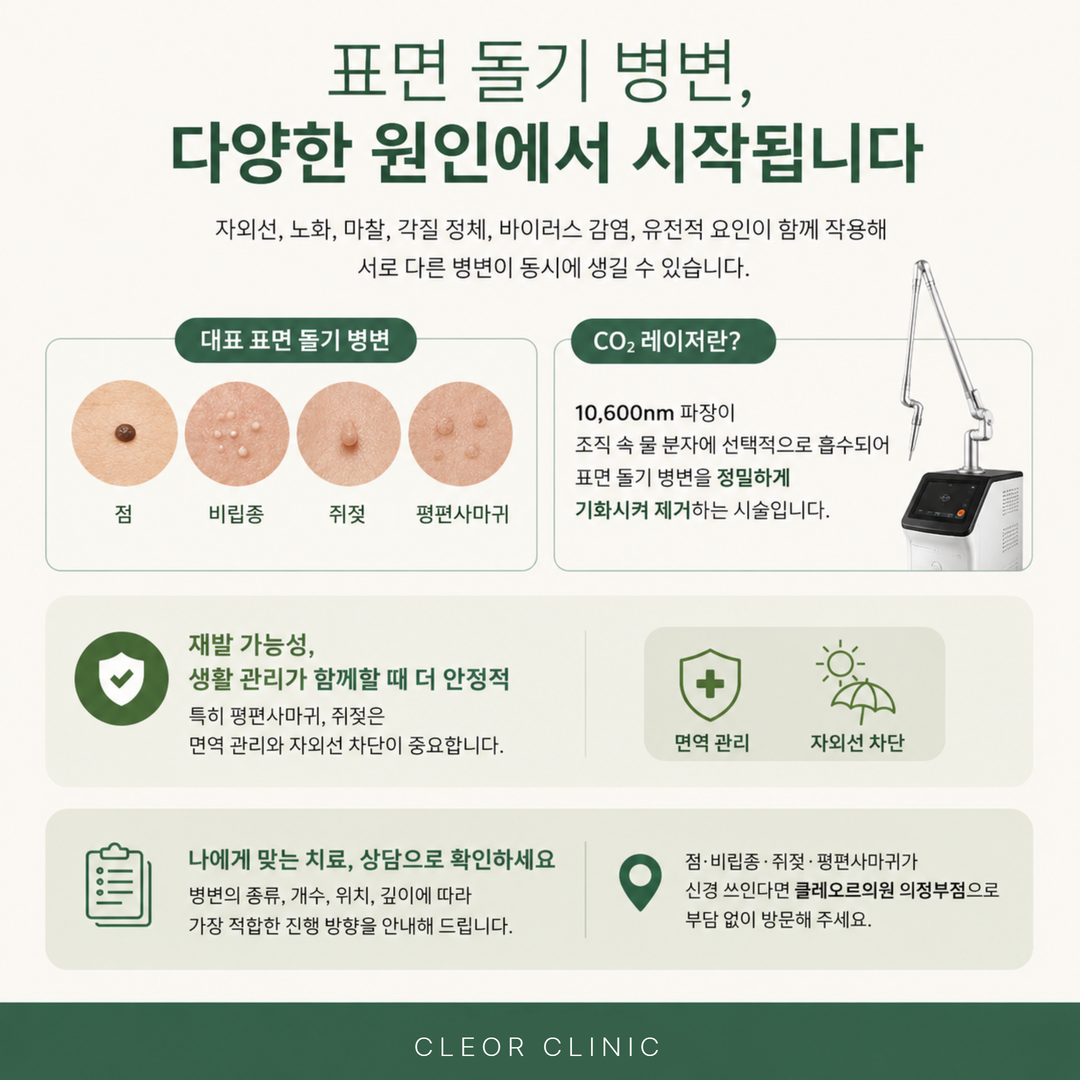
피부 표면 돌기 병변은 한 가지 원인이 아니라 자외선, 노화, 마찰, 각질 정체,
바이러스 감염, 유전적 요인이 함께 작용해
서로 다른 종류가 같은 시기에 동반되는 다요인 변화입니다.
서로 다른 병변에 공통적으로 활용 가능한 라인이 자리 잡은 이유이기도 해요.
의정부 CO2레이저는 10,600nm 파장이
인체 조직 속 물 분자에 선택적으로 흡수되는 원리로
점·비립종·쥐젖·평편사마귀 같은 표면 돌기 병변을
정밀하게 기화시켜 제거하는 시술이에요.
평편사마귀와 쥐젖처럼 바이러스나 체질적 요인이
함께 작용하는 병변은 시술 후에도 재발 가능성이 있는 영역이라
면역 관리와 자외선 차단 같은 생활 관리가 함께 가져가질 때
결과가 안정되는 흐름이라는 점은 함께 이해하시는 게 좋습니다.
본인 병변 종류와 개수·위치·깊이에 어울리는 진행 방향은
상담 시 직접 확인해 드립니다.
점·비립종·쥐젖·평편사마귀 같은 표면 병변이 신경 쓰인다면
클레오르의원 의정부점으로 부담 없이 방문해 주세요.
시술 결정 전이라도 사전 진료를 통해 본인 피부 상태와
어울리는 케어 방향을 자세히 안내해 드리겠습니다.
※ 본 내용은 일반적인 정보 제공을 위한 글이며, 개인에 따라 결과는 달라질 수 있습니다.
정확한 진단과 시술 여부는 전문의 상담을 통해 결정하시기 바랍니다.