
Hello.
I am Dr. Cho Hyuk-chan, Director of Cleor Clinic Uijeongbu Branch.
There are moments when you feel something catching on your fingertips under your eyes while washing your face.
It is so small that you can barely see it even when looking closely in the mirror, but it feels firm to the touch.
Once you start paying attention to it, you may find yourself pressing on that spot several times a day.
Even if you try to squeeze it thinking it is a pimple, nothing comes out,
and I often hear from patients that even after exfoliating, that spot remains exactly the same.
Some say their cotton pad catches on the same spot while removing makeup,
and others say they have tried changing their eye cream, but there was no change.
This means it is located in a place that cannot be reached no matter how much you refine the surface,
and there is a reason for this rooted in the way these granules are formed.
Today, I will explain step-by-step what kind of lesion a milium is, why it does not come out with pressure,
and the principles behind how we approach it.
What is Uijeongbu Milia Removal
👉 Uijeongbu Milia Removal is a care process that clears out a tiny sac formed by a cluster of cells that produce keratin, which has become isolated like an island inside the skin, along with the contents and the wall of the sac.
The wall of this sac is made of cells with the same properties as those that make up the epidermis.
Originally, epidermal cells produce keratin and push it outward.
However, for some reason, when this cluster of cells becomes isolated within the skin,
it continues to produce keratin toward the inner space it surrounds rather than outward.
The keratin, having nowhere to go, accumulates layer by layer to form a lump,
and what you see as a white or yellowish spot through the thin skin is a milium.
There are two paths through which cells become isolated in this way.
One is when it branches off from the uppermost structure of a hair follicle or sweat gland duct without a clear trigger,
and the other is when some epidermal cells remain trapped inside during the process of skin damage and healing, such as from burns, blisters, long-term friction, or past wounds.
Either way, once formed, its nature is the same, making it difficult for it to disappear on its own.
What is often confused with this is closed comedones (whiteheads).
Closed comedones occur when the passage known as a pore originally existed but its entrance became blocked by sebum and keratin,
whereas a milium is a closed space where no passage existed from the beginning.
This difference is exactly why some things come out when pressed and others do not.
Strengths of Uijeongbu Milia Removal
👉 Uijeongbu Milia care uses the property of wavelengths absorbed by water to evaporate only the targeted points.
We approach it by creating a path rather than applying pressure, and we set different conditions for each location.
First, the 10600nm wavelength is absorbed by the water in the tissue, vaporizing that spot.
This wavelength emitted by the CO2 laser is in a range with very high absorption by water, so the moment the light touches the tissue,
the water inside and outside the cells receives energy and instantly boils, turning into steam.
Because the tissue at the point of contact disappears on the spot during that process,
we can create the necessary passage without the need for cutting with a scalpel or stitching.
The fact that the energy is almost entirely consumed by the water in the surface layer, resulting in a narrow depth of penetration,
also plays a role here.
Second, we approach it by creating an exit rather than applying pressure.
The reason it does not come out no matter how much you press with your fingertips or tools is not because of a lack of force,
but because there is no path leading to the outside.
If you press hard to force a path that does not exist, the sac may burst inside the skin,
causing the contents to spread to surrounding tissues and potentially leading to inflammation.
This is why the method of creating a minimal opening on the surface according to the size of the lesion and extracting the contents through that path is the correct sequence for its structure.
Third, we set conditions according to the location and number.
The eyelids and under-eye areas are among the thinnest skin on the body and cannot be treated under the same conditions as the forehead or cheeks,
and when there are many, it is better to divide the area into sessions rather than dealing with everything at once to reduce the burden of surface management.
This distribution is possible because the approach keeps the treated area itself very small.
Operating Principle of Uijeongbu Milia Removal
👉 Uijeongbu Milia Removal creates a minimal exit in the closed space.
After clearing out the accumulated keratin and the wall that produced it, we wait for the surface to close again.
In the first step, we create a path.

By making a very small opening on the surface above the lesion, an exit that did not exist before is created.
It is a principle to keep this opening minimal according to the size of the lesion, so the area treated remains very small when viewed from the outside.
In the second step, we extract the contents.
The keratin lump that was compressed inside comes out through the newly created passage.The reason it comes out at this stage, even though it did not come out when pressure was applied before,
is not because the force has changed, but because a path for it to exit has been created.
In the final step, we clear the sac wall.
If you only extract the contents and leave the sac wall as it is, the cells forming that wall will continue to produce keratin toward the inside,
leaving the possibility that the same spot will slowly fill up again.Therefore, we aim to treat the wall as well to break the process of keratin re-accumulation.
Afterward, a very small scab forms at the treatment site, and epidermal cells move from the edges to cover the surface again.
How you spend this period determines the subsequent surface condition, so care instructions are provided.
Uijeongbu Milia Progression Method and Program
👉 The milia care at Cleor Clinic Uijeongbu Branch operates by treating each lesion as a unit and dividing the scope of the procedure according to the number.Small lesions appearing above or below the surface have different structures and are not grouped under the same category.
Milia, where keratin is trapped inside and felt as granules,
moles, where pigment cells are gathered, skin tags, where the surface is thinly stretched,
and flat warts related to viruses are each divided into different categories.
The units of the procedure also differ by category.
Moles are divided into small, medium, and large according to size, skin tags are divided into small and large,
and milia and flat warts are based on the number.
Even if they look similar on the outside, the approach differs depending on the category, so we distinguish them after checking with magnification during the consultation.
When there are many, we also decide whether to treat them all at once or divide them.
Those who need Milia Removal
Those who feel white granules under their eyes or on their eyelids and are bothered by them every time they wash their face
Those who have tried to squeeze them but they did not come out, so they have left them alone
Those who have tried exfoliating or changing eye products, but that spot remained the same
Those who have difficulty distinguishing between closed comedones and milia and need confirmation
Those who have multiple lesions and want to discuss whether to treat them all at once or divide them
Types of Uijeongbu Epidermal Procedures
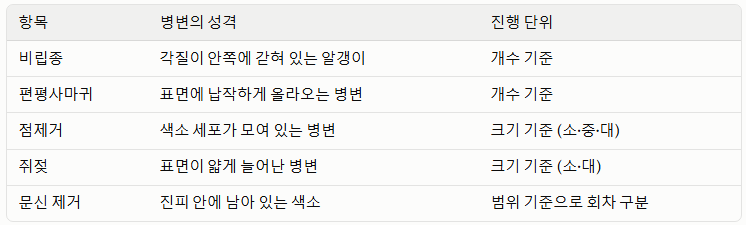
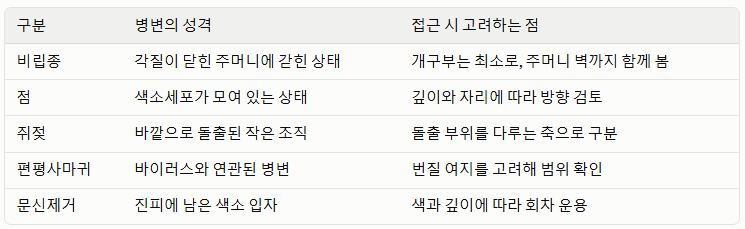
👉 Small lesions appearing above or below the skin surface have different structures, so we determine the approach after first categorizing their nature.
The categories we examine at Cleor Clinic Uijeongbu Branch are summarized below.
Since it is sometimes difficult to determine the nature by the naked eye alone, we confirm it during the consultation before setting the direction.
Side Effects and Things to Know in Advance for Uijeongbu Milia Removal
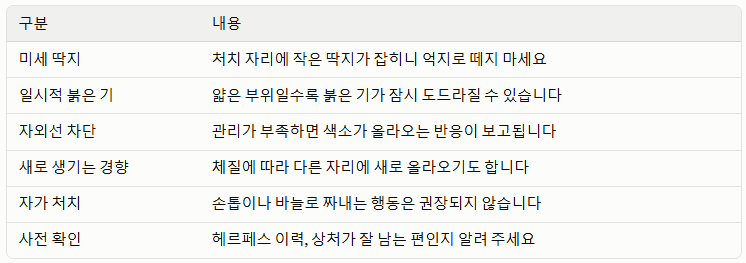
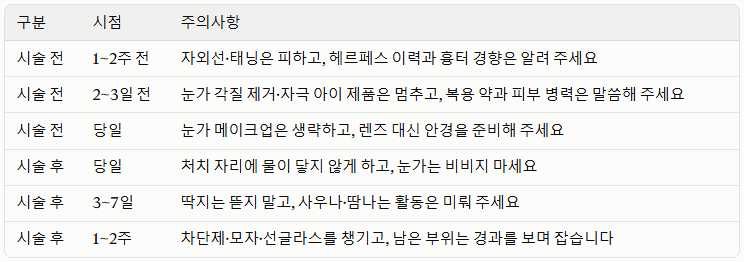
👉 Milia removal is a care process that creates a very small path on the surface, so it is followed by a few days of management.
If you press and treat it with unsterilized tools, the sac may burst inside,
leaving the possibility of inflammation or marks.
While it is difficult to conclude that the oil in eye products causes milia,
your usual eye care habits are included in the items we examine during the consultation.
⚠️ Precautions before and after the procedure
❓ Frequently Asked Questions (FAQ)
Q. Why don't milia come out when pressed?
A. Because there is no passage leading to the outside in the space containing the keratin from the beginning.
Since there is no path to push it out, it does not come out even when pressure is applied,
and if you press hard forcibly, the sac may burst inside, potentially spreading inflammation.
Q. How do milia form?
A. There are cases where they form by branching off from the upper structure of a hair follicle or sweat gland duct without a clear trigger,
and cases where they form because epidermal cells are trapped inside during the process of skin damage and healing, such as from burns, blisters, or long-term friction.
Q. How do you distinguish between milia and closed comedones?
A. Closed comedones are a state where the entrance to the passage known as a pore is blocked,
while milia are a closed space where the passage itself does not exist.
Since their nature is different, the approach is also divided, so we check during the consultation first.
Q. What is the principle of the laser used for milia?
A. It uses the property that the 10600nm wavelength is very well absorbed by water in the tissue.
The moment it touches, the water at that point boils and turns into steam, causing the tissue to disappear on the spot,
so we can create only the very small passage needed.
Q. Do milia grow back in the same spot?
A. If you clear out the sac wall that was producing the keratin as well, it is reported that the occurrence of the same spot filling up again is reduced.
However, depending on skin conditions and constitution, there are cases where they appear in new locations.
Q. Do you treat all milia at once if there are many?
A. It depends on the number and location.
When thin areas like eyelids are mixed in or when the number is large, it is better to divide the area into sessions to reduce the burden of surface management, so we discuss the distribution during the consultation.
Milia are not a concept of rubbing the surface to remove them,
but rather a process of creating a very small path in a closed space formed by a cluster of cells that produce keratin isolated inside the skin, and clearing out the contents and the wall together.
As the reason they did not come out when pressed and could not be reached by exfoliation lay in this structure,
the approach is also set according to the structure.
Because it is a method that uses the property of wavelengths absorbed by water to evaporate only the touched points, we can keep the treated area very small,
and we set different conditions for thin areas like eyelids versus the forehead or cheeks.
At Cleor Clinic Uijeongbu Branch, we examine the location, depth, and number of the lesions together and confirm them directly during the consultation.
If you are seeing lesions of different natures, such as moles or skin tags, on the same day, we may also divide the sequence.
If you have felt the same spot catching every time you wash your face, please feel free to talk to us about it.
※ This content is for general information purposes only, and changes may vary depending on the individual.
Please determine the exact diagnosis and whether to proceed with the procedure through a consultation with a specialist.
눈꺼풀처럼 얇은 부위가 섞여 있거나 개수가 많을 때는 부위를 나누어 회차를
두는 편이 표면 관리 부담을 낮추는 방향이라 진료에서 배분을 상의합니다.
비립종은 표면을 문질러 없애는 개념이 아니라,
각질을 만들어 내는 세포 무리가 피부 안에 고립되어 만든 닫힌 공간에
아주 작은 길을 내고 안의 내용물과 벽을 함께 정리하는 과정에 가깝습니다.
눌러도 나오지 않고 각질 제거로도 닿지 않던 이유가 이 구조에
있었던 만큼, 접근도 구조에 맞춰 잡게 됩니다.
물에 흡수되는 파장의 성질을 이용해 닿은 지점만 증발시키는
방식이라 다루는 면적을 아주 좁게 유지할 수 있고,
눈꺼풀처럼 얇은 자리와 이마나 볼은 조건을 나누어 잡습니다.
클레오르의원 의정부점에서는 병변의 자리와 깊이,
개수를 함께 살펴 상담 시 직접 확인해 드립니다.
점이나 쥐젖처럼 성격이 다른 병변을 같은 날 보시는 경우에는 순서를 나누어 잡기도 합니다.
세수할 때마다 같은 자리가 걸리셨다면, 편하게 한 번 이야기 나눠 보셔도 좋겠습니다.
※ 본 내용은 일반적인 정보 제공을 위한 글이며, 개인에 따라 나타나는 변화는 달라질 수 있습니다.
정확한 진단과 시술 여부는 전문의 상담을 통해 판단하시기 바랍니다.