

Hello.
I am Dr. Hyuk-chan Jo, Director of Cleor Clinic Uijeongbu Branch.
Patients who have received pigmentation treatment a few years ago often tell me this during consultations:
"It definitely faded back then, but after the following summer, the same spots reappeared,
and this time, the area seems a bit wider than before."
The reason melasma behaves this way lies in the nature of the lesion.
Melasma is not a spot that disappears once it is removed;
it is a condition where pigment-producing cells react to UV rays, hormonal changes, and heat touching the skin,
continuously over-producing pigment over a long period.
Because those triggers remain in your daily life, melasma requires ongoing maintenance.
In some cases, dilated blood vessels are also observed, so we assess the condition by categorizing it.
Therefore, for melasma, a plan that involves periodic care over time is more suitable than a single, aggressive treatment.
Today, I will explain what kind of wavelength Uijeongbu Melasma Toning uses,
why the number of sessions is specified in advance,
and what you need to take care of between sessions.
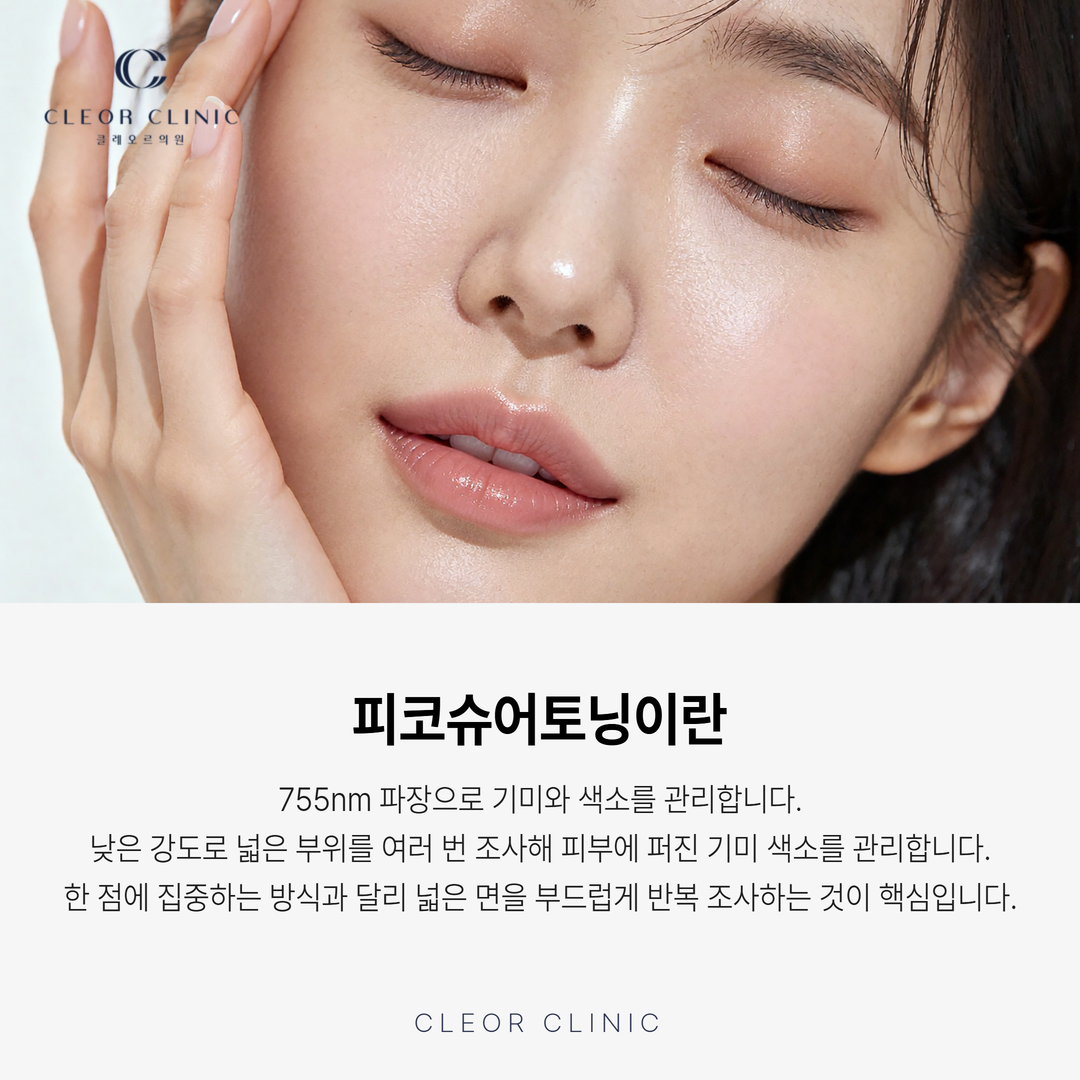
What is Uijeongbu Melasma Toning?
👉 Picosure Toning is a pigmentation care treatment that uses a 755nm Alexandrite picosecond laser at a low intensity,
passing over the area multiple times to periodically manage the surface where melasma has appeared.
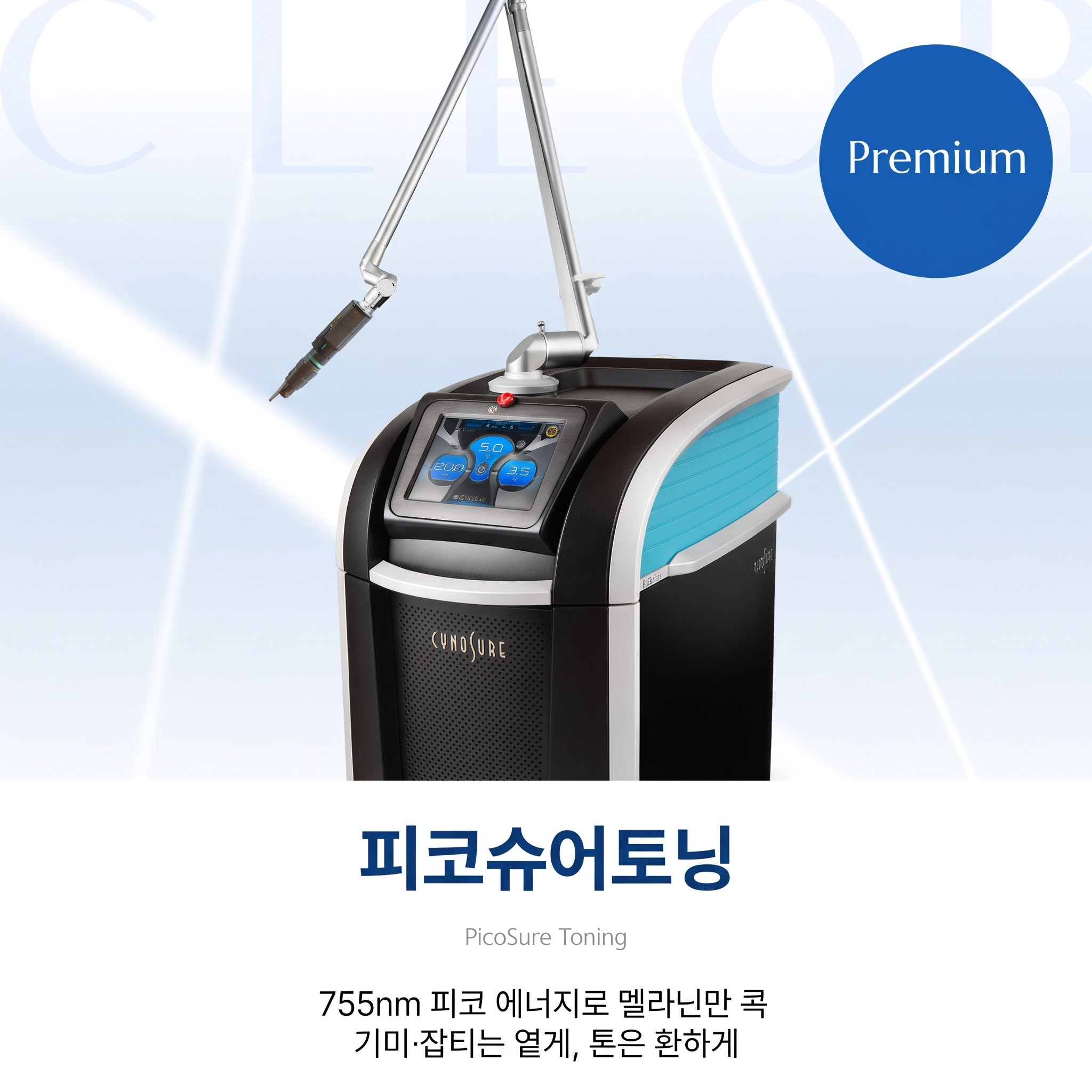
The equipment used at Cleor Clinic Uijeongbu Branch is Picosure.
This device has been approved by the US FDA for the treatment of melasma, Nevus of Ota, and Hori's nevus using the 755nm wavelength.
The fact that the lesion name 'melasma' is explicitly included in the approved indications
makes it clear what this device is intended to treat.
However, even with the same device, the target area changes depending on how the light is emitted.
If you lower the intensity and pass over a wide area multiple times, you target the spread-out pigmentation;
if you use a lens to focus the light into a single point, you target areas with depth, such as scars.
Since melasma is a pigmentation that spreads across a surface, we manage it by passing over the wide area at a low intensity.
Recommended for those who:
Have blurred, spread-out pigmentation on both cheekbones.
Feel that the same spots reappear every time summer passes.
Have received pigmentation treatment but found it difficult to maintain the results.
Are concerned about whether to address redness or pigmentation first.
Prefer to continue with spaced-out sessions rather than receiving one aggressive treatment.
Why melasma requires maintenance
👉 Because melasma is a lesion where the causative triggers remain in your daily life, the care period continues even after completing the sessions.
First, the stimulation does not end.
UV rays do not disappear, they only decrease in amount depending on the season,
and heat from cooking or saunas also acts in the same way.
When pigment-producing cells receive these stimuli, they produce pigment again.
Second, pigment is not located in just one layer.
Melasma often consists of a mixture of pigment remaining in the epidermis and pigment that has settled deeper.
If you increase the intensity to remove it all at once,
the pigment-producing cells may react defensively and produce even more pigment.
That is why we use a method of lowering the intensity and accumulating sessions.
Third, there may be vascular components involved.
If dilated blood vessels are observed in the area where melasma has appeared,
a treatment plan focusing only on pigmentation will have limited effectiveness.
This is why Cleor Clinic Uijeongbu Branch offers a separate customized toning for vascular melasma.
Technical Features
👉 The features are divided into the 755nm wavelength, the picosecond pulse duration, and the fact that it does not penetrate the surface.
First, the wavelength is 755nm.
This wavelength, emitted from an Alexandrite medium, has high absorption in pigment,
allowing it to target both pigment in the epidermis and pigment that has settled deeper.
This is the wavelength for which melasma is listed as an indication in the approval documents.
Second, the emission time is in picoseconds.
Even with the same amount of energy, if the emission time is short,
the energy transfer ends before heat can spread to the surrounding area.
This allows for a treatment that focuses solely on the pigment while reducing the burden on the surface.
Third, it does not penetrate the surface.
Because we use low intensity and multiple passes, it does not go through stages like scabbing or oozing.
In many cases, the skin only shows temporary redness that subsides,
making it easier to continue sessions without clearing your schedule.
Composition and Program
👉 The program at Cleor Clinic Uijeongbu Branch combines toning management with recording items,
and is divided according to the nature of the melasma and the number of sessions.
The reason 8 sessions are specified for vascular melasma customized toning
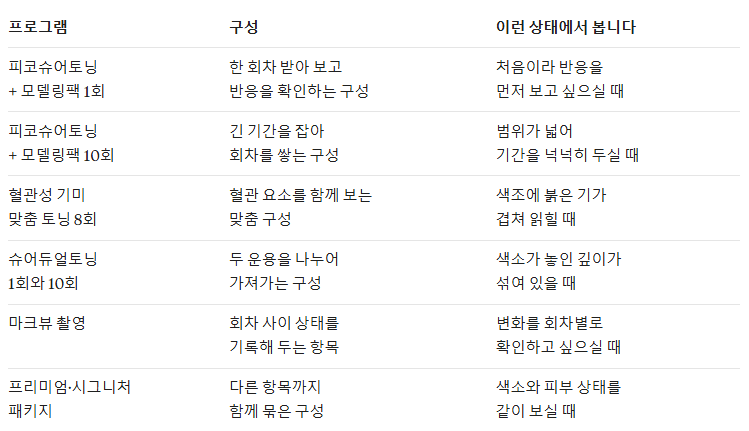
is because melasma is a lesion that requires care through accumulated sessions.
The interval is determined by considering both the skin's recovery speed and the season.
Strengths of Uijeongbu Melasma Toning
👉 The strengths are that melasma is included in the indications, it is easy to continue sessions due to the low surface burden,
and the condition can be recorded and compared.
First, melasma is included in the approved indications.
The 755nm wavelength used in Picosure Toning is FDA-approved
for the treatment of melasma, Nevus of Ota, and Hori's nevus.
Unlike pigmentation lasers that are vaguely described as being for general pigmentation,
the name of the lesion 'melasma' is explicitly included in the approval.
Therefore, during consultation, we first check if the pigmentation is indeed melasma before setting a direction.
Second, it is easy to continue sessions.
Because it is a non-penetrating treatment, it does not involve scabbing,
and in many cases, it only involves temporary redness that subsides.
This is a suitable approach for a lesion that requires long-term observation like melasma.
There are individual differences in the degree and timing of the effects felt.
Third, the condition can be recorded.
If you include Mark-Vu imaging between sessions,
you can compare the changes you were estimating by eye under the same conditions.
Since melasma is a slowly changing lesion, records are particularly useful.
Side Effects and Points to Note
👉 Points to note are focused on the reaction for a few days after the procedure and the fact that melasma is a lesion that can reappear.
This treatment is effective for managing blurred, spread-out pigmentation over a long period.
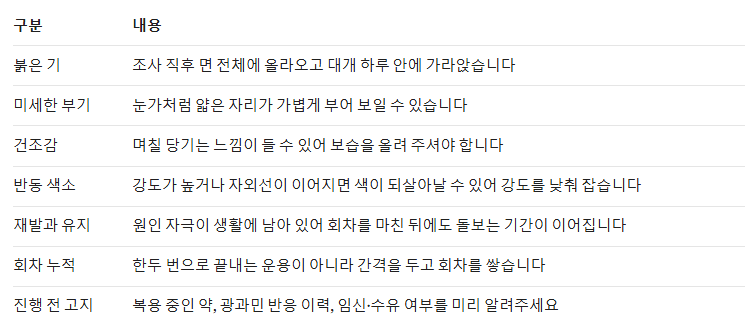
If you plan by combining sessions, intervals, and protection during the periods between, your direction will become clearer.
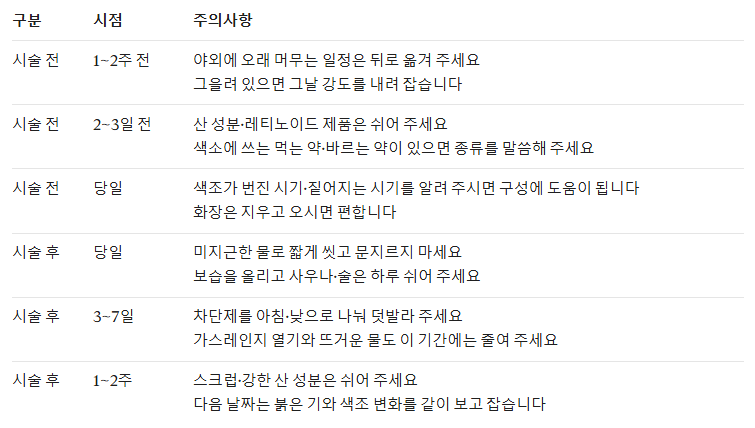
⚠️ Precautions before and after the procedure
❓ Frequently Asked Questions (FAQ)
Q. Will my melasma disappear after the treatment?
A. Melasma is different in nature from spots that can be removed at once.
Because the causative triggers remain in your daily life, it is a lesion that requires care through accumulated sessions,
and continued protection and heat management even after finishing.
There are individual differences in the degree and timing of the effects felt.
Q. How is it different from a blemish laser?
A. The lesions being treated are different.
Spots with clear borders are suitable for treatments that target those specific points,
while blurred, spread-out pigmentation is suitable for treatments that pass over a wide area at low intensity multiple times.
If both types are mixed on one face, we divide the order of treatment.
Q. Is it very painful?
A. You will feel a stinging sensation as it passes over the area, along with a warm feeling.
Because it is a treatment that lowers the intensity and divides it into multiple passes, the burden is not significant,
and if you tell us how you feel, we will adjust the intensity for that day.
Q. How many sessions will I need?
A. It depends on the depth and range of the pigment, and the degree of vascular components mixed in.
Therefore, we have separate 1-session, 8-session, and 10-session packages and decide based on your condition.
Q. What should I take care of between sessions?
A. You must first prioritize UV protection.
Even while accumulating sessions, if UV rays enter, the pigment-producing cells will react again,
so using sunscreen consistently will help you maintain the intervals.
Q. I have redness as well; can I treat both at once?
A. We have a separate customized configuration that addresses vascular components together.
However, the order depends on which factor is more prominent, so we check your condition before proceeding.
Uijeongbu Melasma Toning is a pigmentation care treatment that uses a 755nm picosecond laser at a low intensity,

passing over the area multiple times to manage blurred, spread-out pigmentation over a long period.
Melasma is included in the 755nm indications in the approval documents,
and because it is a non-penetrating treatment, it is easy to continue sessions.
Because melasma is a lesion where the causative triggers remain in your daily life,
you will continue protection and heat management even after finishing the sessions.
Therefore, we plan by combining a customized configuration that addresses vascular components and recording items.
Cleor Clinic Uijeongbu Branch also operates Picosure Toning and Derma V Perfect Toning,
so you can divide the order according to the depth of the pigment.
We will personally check which configuration is best for you during your consultation.
If you are concerned because the spots that faded last year have reappeared this year,
please feel free to ask us on our KakaoTalk channel.
※ This content is for general information purposes only, and changes may vary by individual.
Please determine the exact diagnosis and whether to proceed with the procedure through a consultation with a specialist.
정확한 진단과 시술 여부는 전문의 상담을 통해 판단하시기 바랍니다.