
Hello.
I am Dr. Hyuk-chan Jo, Director of Cleor Clinic Uijeongbu Branch.
There are days when your base makeup looks fine in the morning,
but by the afternoon, the product settles into indented areas, making the marks more noticeable.
If you apply another layer to cover them, the thickness only changes in those spots, making them stand out even more.
The reason they are still visible even after covering them is that the shape of the mark was created below the surface.
After acne subsides, the remaining marks are divided into those with residual color and those with residual depth.
Color tends to fade over time, but areas where inflammation reached the dermis and broke down collagen
remain fixed in their shape. Furthermore, the fibrous bands that form during the healing process
pull the surface from underneath, so no matter what you apply on top, the shape does not smooth out.
Therefore, we approach indented marks by placing the point of action deep within the dermis.
I will explain in order how the Uijeongbu indented scar laser uses specific lenses,
how we determine the treatment area based on the shape of the marks,
and what the 5-week and 10-week labels mean.

What is the Uijeongbu indented scar laser?
👉 The Uijeongbu indented scar laser is a scar care treatment that uses a 755nm laser emitting light in picosecond units,
equipped with a focus lens to concentrate energy into multiple small dots, delivering it to the dermis beneath the indented marks.
Cleor Clinic Uijeongbu Branch refers to the operation of the Picosure with a focus lens
as Picosure Fraxel.
It is a technique designed to treat acne scars,
and the intensity is adjusted according to the skin's natural tone.
The fact that the purpose of this technique is clear determines its scope.
If you use the same equipment to cover a wide area at low intensity, you are targeting pigmentation, but if you attach a lens to
emit light in dots, you are targeting areas with residual depth.
Criteria for classifying types of indented marks
👉 Even for the same type of indented mark, the approach differs depending on the width, depth, and edge shape.
There are narrow and deep marks.
The opening is as narrow as a needle hole, but it extends deep downward.
Because it is difficult for light coming from above to reach the bottom,
we aim to build up the walls layer by layer rather than flattening them all at once.
There are marks with angular edges.
The opening is distinct, and the walls drop almost vertically.
When the angular edges are hit by light, they create shadows,
making them appear deeper than they actually are.
There are wide and gentle marks.
The boundaries slope down softly, making the entire area look like a gentle wave.
They are hard to notice individually, but they become visible when light hits them at an angle.
In most cases, all three types are mixed on one face.
Therefore, we first observe which type is more prevalent and where they are concentrated
to determine the scope and duration of treatment.
Why we concentrate energy into dots
👉 Even with the same amount of light, the depth reached depends on how it is distributed.
If you spread it evenly over a wide area, the amount of energy per spot is shallowly dispersed.
Because the focus lens concentrates that light into multiple small dots,
the amount received by each dot increases, allowing it to penetrate deeper.
We use this structure when the area that needs treatment, such as an indented mark, is deep.
The use of a 755nm wavelength is also related to depth.
This wavelength, emitted from an alexandrite medium, passes through the epidermis and enters the upper dermis.
Since the layer where collagen has broken down is located at that exact depth,
the point of action and the target meet at the same spot.
The energy concentrated into dots is consumed within the dermis, leaving behind very small stimulation points.
While the body moves to fill those spots, the surrounding collagen is newly replenished.
Since it is not a method that removes the epidermis, it is easy to continue your schedule the day after the procedure,
and after the procedure, we apply a modeling pack to soothe the surface.
Composition and Program
👉 We divide the scope into the butterfly zone and the entire face, and offer separate packages for indented scars with longer durations.
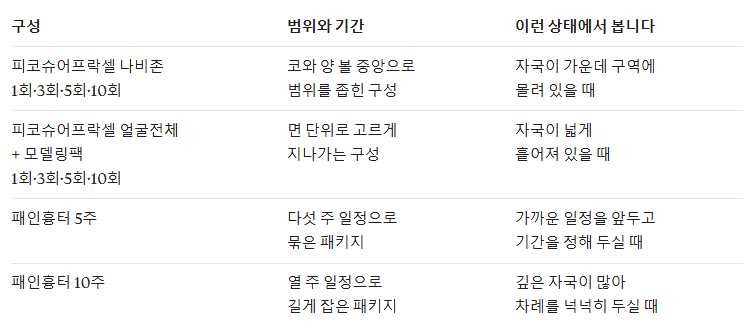
The butterfly zone is the area covering the nose and the center of both cheeks.
It is the area where acne marks are most concentrated,
and because it is the area that faces light directly, it is read more clearly even at the same depth.
We narrow the scope when you want to focus only on that area.
The full-face configuration is used when marks are widely scattered.
If you only treat one area, the difference from the surrounding skin may be visible,
so we choose to treat the entire area evenly.
The reason there are packages labeled by weeks instead of number of sessions is
because it takes time for the dermis to react and regenerate.
The plan is based on the duration over which the treatment is accumulated rather than how many times you receive it.
The scope and duration are determined during the consultation by looking at the type and distribution of the marks, as well as your available schedule.
Strengths of the Uijeongbu indented scar laser
👉 The strengths are that it is a technique designed for scars, it leaves the epidermis intact while placing the point of action in deep areas,
and the scope and duration can be designed separately.
The fact that the target is clear serves as a standard during consultation. The technique using a focus lens is
used to treat areas with residual depth like scars, and if the skin tone is dark, the amount of
light absorbed by the epidermis increases, so the intensity is set after checking the skin tone.
Leaving the epidermis intact makes a difference in your schedule.
Techniques that remove the epidermis have a wider range of treatment but require a longer healing period.
This method places energy concentrated in dots inside, making it easier to continue your daily life the next day.
Redness and a feeling of tightness may persist for a few days.
The ability to plan the scope and duration separately is also well-suited for indented marks.
Whether to narrow it down to the butterfly zone or treat the entire face,
or whether to set it for five weeks or ten weeks, is decided according to your condition and schedule.
Marks with depth are not resolved in one or two sessions, so duration planning is particularly important.
The degree and timing of the results vary from person to person.
Recommended for those who:
Have makeup settle into indented areas by the afternoon, making marks more visible.
See the center of their cheeks appear to sag gently when light hits at an angle.
Have acne that has subsided, but the indented marks remain.
Are concerned about the healing period of techniques that remove the epidermis.
Want to plan based on a set duration rather than a number of sessions.
Side effects and things to know in advance
👉 Things to keep in mind are centered on the reaction from the day of the procedure for a few days and the method of accumulating results over a period of time.
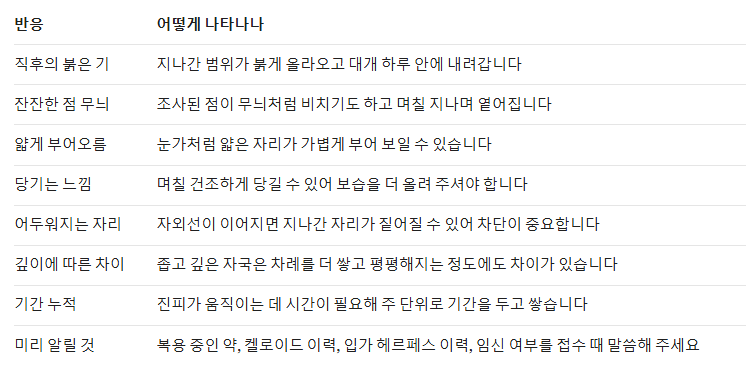
The area this technique targets is marks where depth remains and shadows settle depending on the lighting.
If you plan by setting the scope and allowing sufficient time, the direction becomes clear.
⚠️ Precautions before and after the procedure
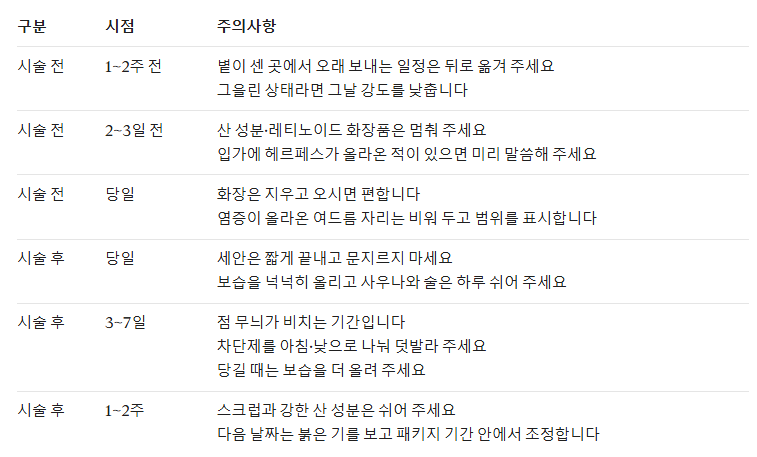
❓ Frequently Asked Questions (FAQ)
Q. How is it different from toning with the same equipment?
A. The lens is different.
Toning involves passing over a wide area multiple times at low intensity to target pigmentation,
while the technique using a focus lens concentrates energy into dots to target areas with residual depth.
It is not a matter of which is better, but that they target different areas.
Q. Can I just get the butterfly zone treated?
A. If the marks are concentrated on the nose and the center of both cheeks, we narrow the scope.
If they are scattered to the surrounding areas, we recommend treating the entire area.
Q. Is it very painful?
A. You may feel a stinging sensation when the energy concentrated into dots passes through,
and a feeling of heat as we cover the area.
We apply topical anesthesia before proceeding, and we can adjust the intensity if you let us know how it feels.
Q. Is it okay to go to work the next day?
A. It is not a technique that removes the epidermis, so many people return to their daily lives immediately.
However, redness and a feeling of tightness may persist for a few days, so please ensure you moisturize and use sun protection.
Q. Should I choose 5 weeks or 10 weeks?
A. We look at the depth and distribution of the marks, as well as your available schedule.
If there are many deep marks, a longer duration is more comfortable for building up the results.
Q. What should I be most careful about after the procedure?
A. Moisturizing and sun protection.
If UV rays hit the treated area while it is healing, the area may darken,
so it is recommended to use sunscreen consistently throughout the package period.
The Uijeongbu indented scar laser uses a focus lens to concentrate light into small dots
to deliver it to the dermis beneath the indented marks.
Because it leaves the epidermis intact and places the point of action inside,
it differs from removal techniques in terms of healing period and target area.
Indented marks are classified by type according to width, depth, and edge shape,
and multiple types are often mixed on one face.
Therefore, we have divided the scope into the butterfly zone and the entire face,
and created separate packages with durations such as five weeks and ten weeks.
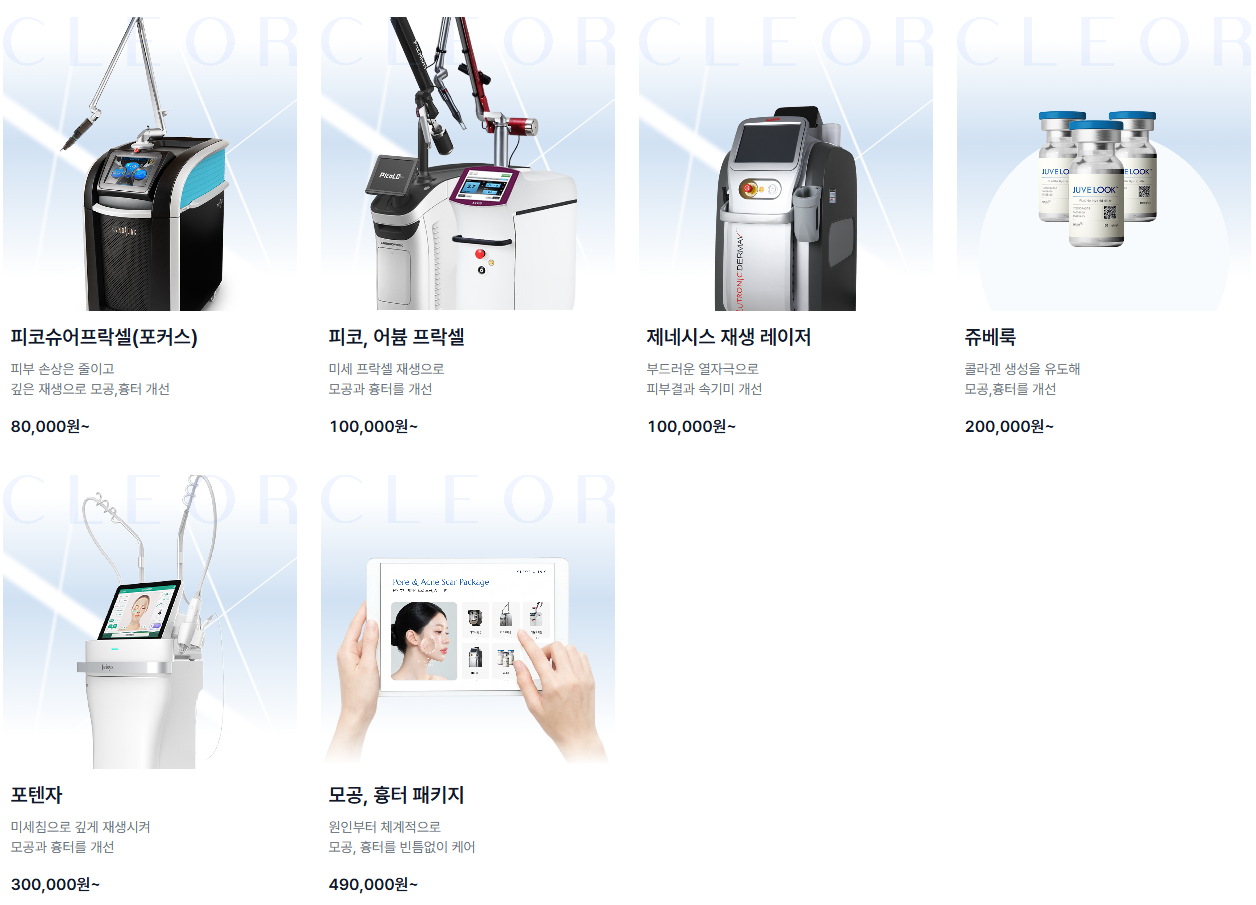
Cleor Clinic Uijeongbu Branch also operates Potenza and Erbium Fraxel,
so you can receive treatments in sequence depending on the type of mark.
We will personally confirm which scope and duration are right for your current condition during the consultation.
If you have noticed the same areas every time the lighting changes,
you can also write down your current condition on our KakaoTalk channel.
※ This content is for general information purposes only, and changes may vary from person to person.
Please consult with a specialist to determine the exact diagnosis and whether to proceed with the procedure.