

Hello.
I am Dr. Cho Hyuk-chan, Director of Cleor Clinic Uijeongbu Branch.
When you look at your face in a place where the light falls from above, like in an elevator mirror,
you may sometimes notice that the area next to your cheeks, which usually doesn't look like anything in front of the bathroom mirror, suddenly appears uneven.
This is because when light enters at an angle from above or the side, even a slight depression creates a shadow,
and I often hear patients say that it was at that moment they truly realized the depth of their skin marks.
The period of active acne has already passed,
and the redness has faded, but the marks remain.
The reason these irregularities do not fill in no matter how many topical products you apply
is that the change is not on the surface, but in the dermis below.
The way the supporting tissue that fills the dermis accumulated while the wound was healing
created the shape you see now.
Today, I will explain in order how Uijeongbu scar laser treats the skin by dividing it into units,
why the depth reached and the residual heat differ for each wavelength,
and what the strengths and points to keep in mind are.
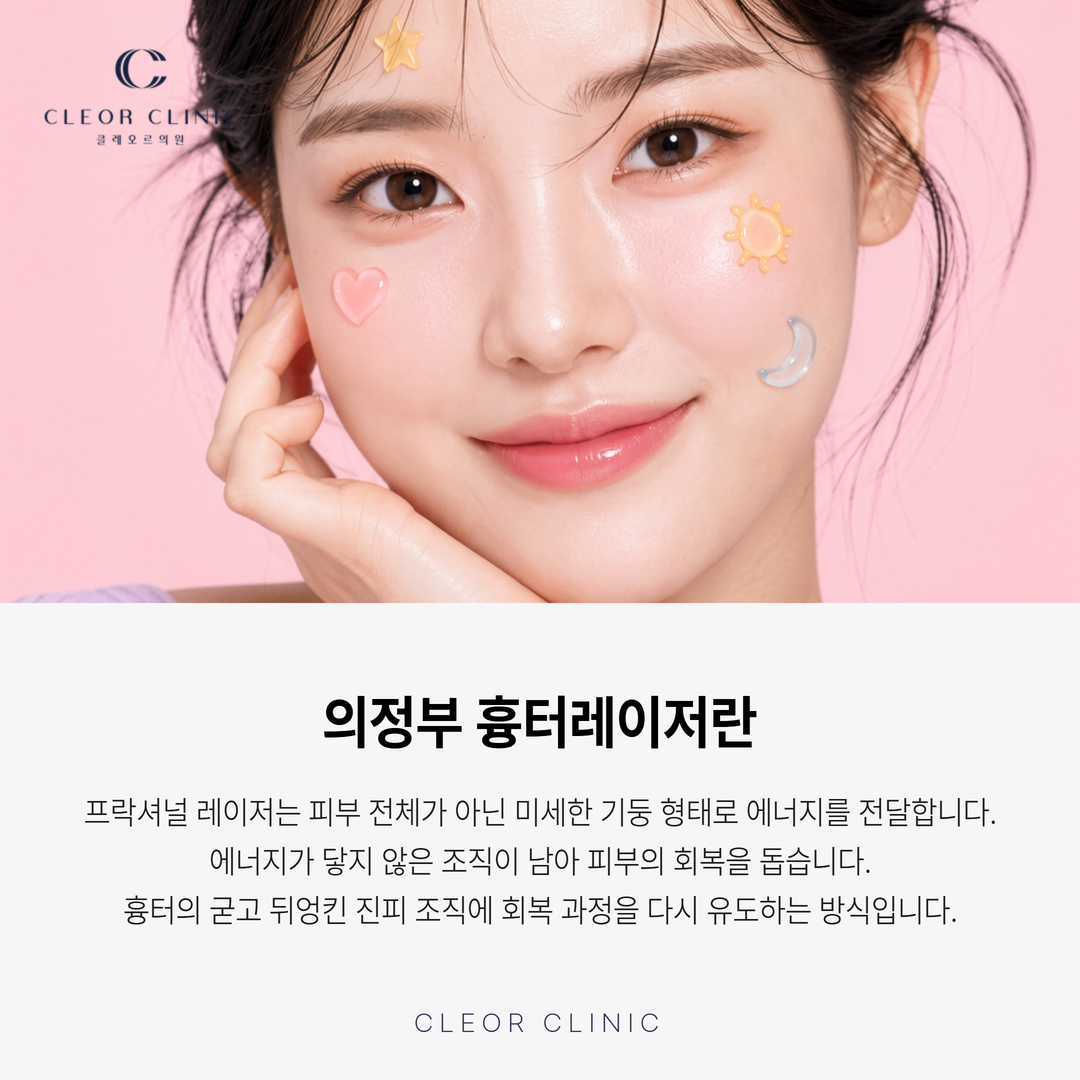
What is Uijeongbu scar laser?
👉 Uijeongbu scar laser is a treatment designed to allow the intact tissue left in between to lead the recovery by delivering energy in tiny, column-like divisions rather than treating the entire skin surface at once.
The term 'fractional' means dividing the surface into small parts.
When a laser beam is split into dozens to hundreds of very thin rays and applied to the skin,
a thin, column-shaped treatment zone is created from the surface to the dermis where each ray touches,
and tissue that has not been touched by any energy remains between the columns.
The point that distinguishes it from methods that treat the entire surface is this remaining part.
The reason scars do not resolve on their own lies in the state of the supporting tissue within the dermis.
When a wound heals in a hurry, fibers are
pushed in one direction or become tangled randomly and harden,
and once hardened, the tissue does not loosen or reorganize itself over time.
Therefore, an approach that focuses on the surface is not enough;
an approach that reactivates the recovery process in the hardened area is necessary.
Strengths of Uijeongbu scar laser
👉 The strengths of Uijeongbu scar laser lie in the ability to select the depth reached according to the wavelength, the intentional preservation of untreated tissue,
and the ability to categorize and address the nature of the marks.
First,
the depth and residual heat vary depending on the degree to which the wavelength is absorbed by water.
Since skin is mostly made of water, how deep the laser penetratesdepends on how well the wavelength is absorbed by water.
The 2940nm Er:YAG laser has a very high water absorption rate,
so as soon as the energy touches, it is almost consumed in the surface layer,
leaving little heat in the surrounding area and precisely refining the area near the surface.
The 10600nm CO2 laser has lower water absorption than that,
so the energy penetrates a little deeper and heat remains around the columns,
and this residual heat acts to contract the supporting tissue and turn on regeneration signals.
The basis for choosing which characteristic to use depends on whether the mark is shallow and spread out or narrow and deeply pitted.
Second,
untouched tissue is intentionally left behind.
The epidermis and dermis remaining between the columns serve as the starting point for covering the wound.
Because cells attached to the edges of the treated columnsmove from the sides to the inside to cover the surface again,
the time it takes for the surface to close is shorter than when the entire surface is treated.
Because it is configured to allow stimulation to the dermis while maintaining a manageable recovery period,
it is easy for those who cannot take much time off to continue with split sessions.
Third,
the nature of the marks can be categorized and addressed.
Even for marks on the same cheek, pitted irregularities are a volume issue of the dermis,
red marks are a problem of dilated micro-vessels,and brown marks are a problem where more melanin was produced after inflammation passed.
These three have different causes and cannot be grouped into one category.
It is clearer to set the direction by dividing them: fractional types for irregularities, vascular-focused items for redness,
and pigmentation-focused items for brown marks.
Operating principle of Uijeongbu scar laser
👉 Uijeongbu scar laser proceeds in the order of creating microscopic columns, pushing the old tissue within those columns upward, and having new supporting tissue fill the empty space.
A thin column is created from the surface to the bottom where the laser ray touches,
and the tissue inside is heated and solidified.
This solidified mass does not stay in the skin,
but is pushed upward as new cells rise from below and falls off the surface over several days.
The appearance of tiny dot-shaped scabs for a few days after treatment is this stage,
and the pigment trapped in the hardened tissue is also carried away at this time.
At the same time, recovery signals are turned on around the columns.
Fibroblasts in the remaining tissue are activated to create new supporting fibers,
and these fibers fill the area where the columns were and its surroundings from the bottom up.
Unlike the past when they were piled up randomly in a state of urgent inflammation, this process takes place under controlled conditions,
so there is room for new fibers to be laid out along the weave of the surrounding tissue.
The tissue filled in this way changes into a firmer and more stable form over several weeks.
Because the area treated in one session is only a part of the whole, it does not change significantly at once,
and it is common to operate by building up sessions while changing the treated areas.
It is accurate to understand it as a method where the depth and wall slope of the pitted area
become slightly more gradual with each session.
Who is Uijeongbu scar laser for?
Those who are bothered by pitted marks remaining after acne has subsided
Those whose irregularities are particularly visible in angled light or lighting falling from above
Those who have a mix of irregularities, redness, and brown marks and want to set an order for treatment
Those who have had marks for a long time and want to start refining them now
Those who prefer to continue with split sessions rather than one strong treatment
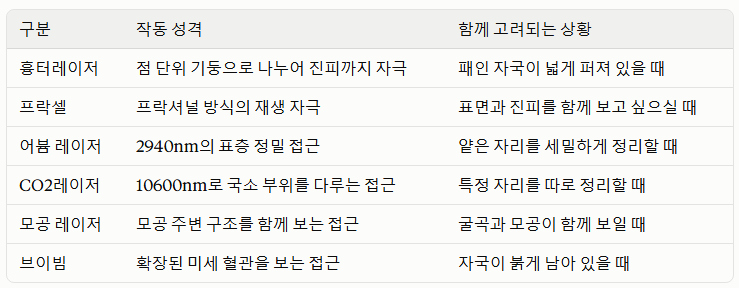
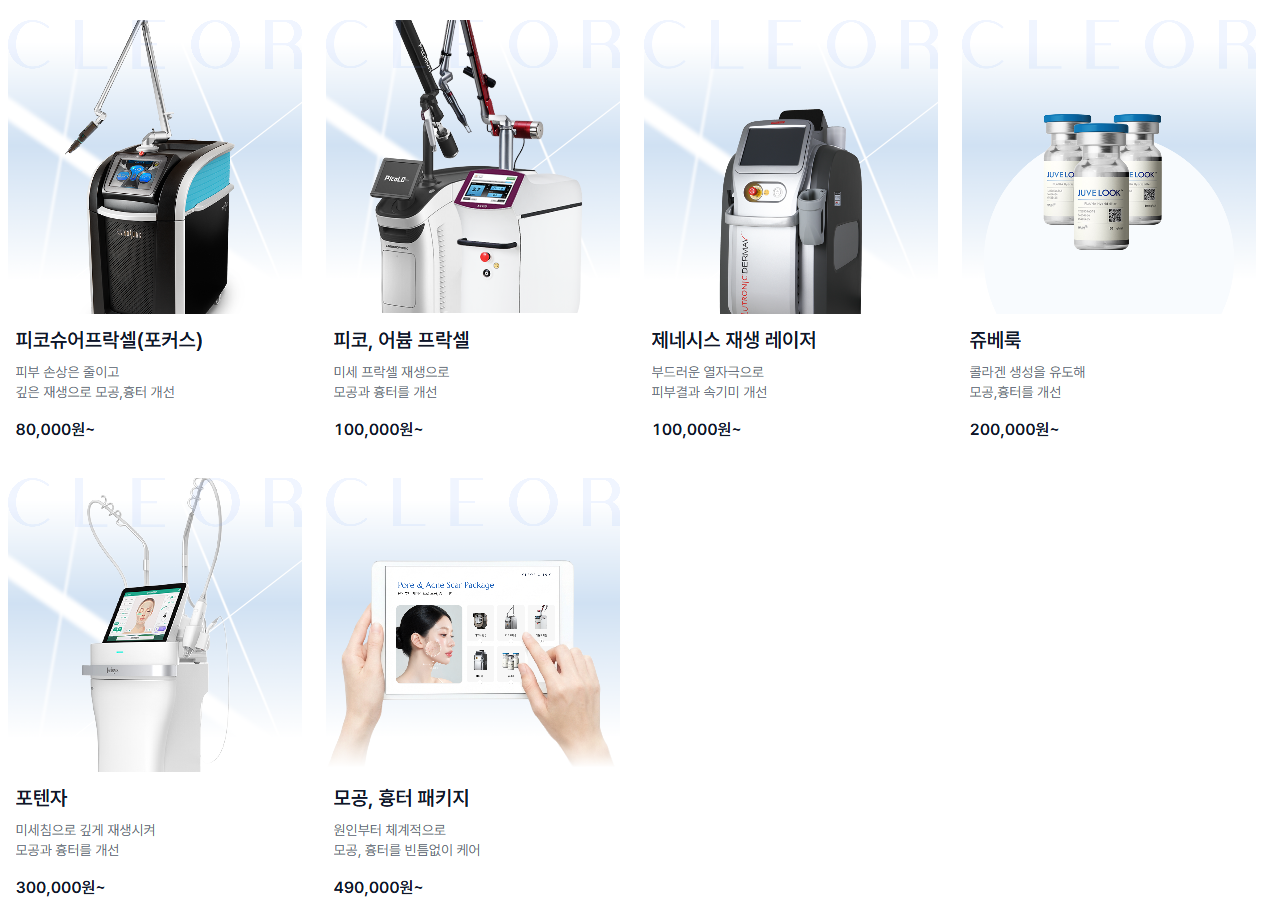
Types of Uijeongbu skin lasers
👉 Lasers that treat marks have different characteristics depending on the wavelength and the method of energy delivery.
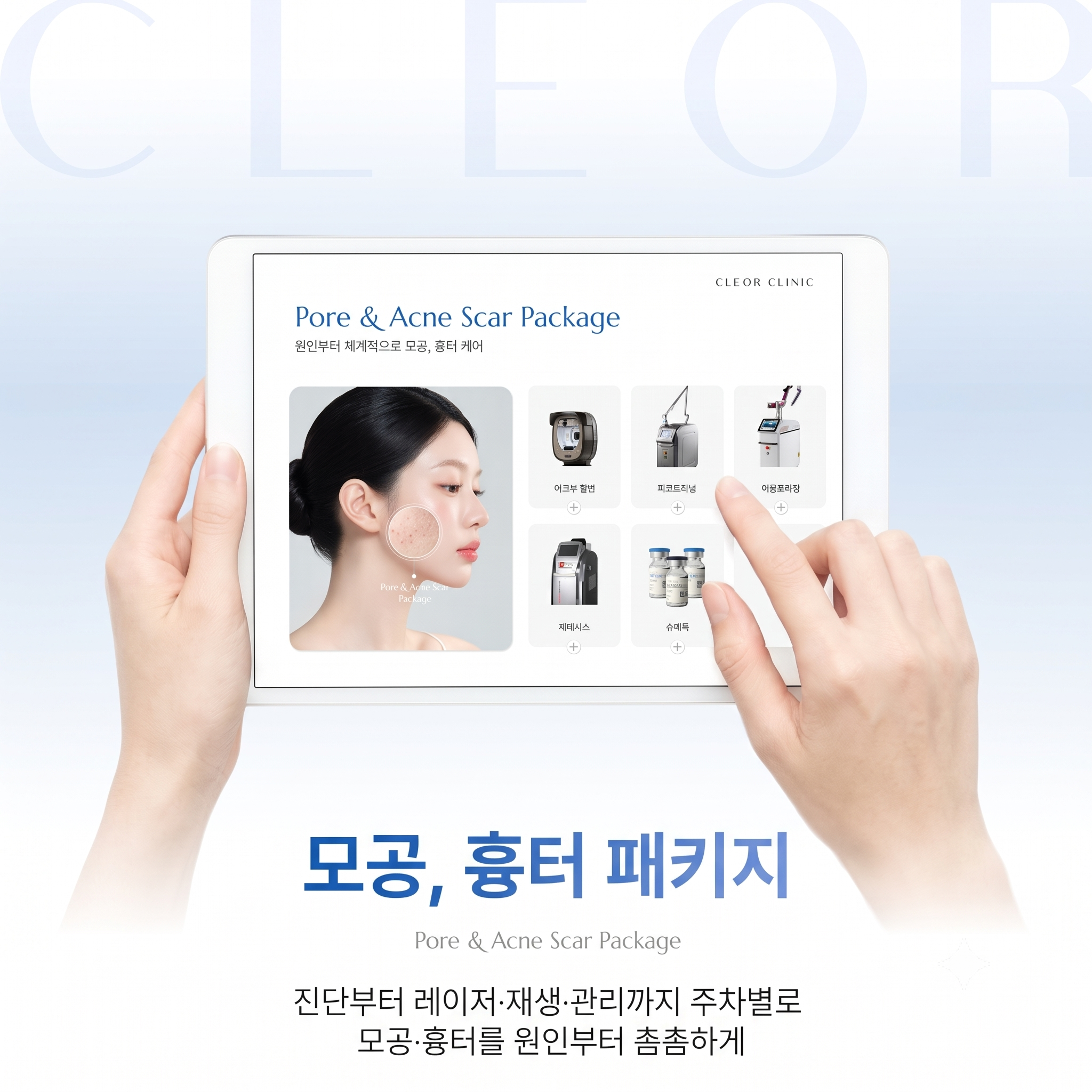
The related items operated at Cleor Clinic Uijeongbu Branch are summarized below by characteristic.
Since the appropriate combination depends on the type, depth, and onset of the marks,
we set the order after checking during the consultation.
Uijeongbu scar laser side effects and points to keep in mind
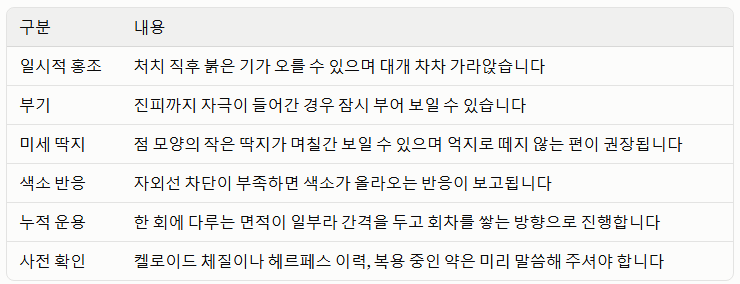
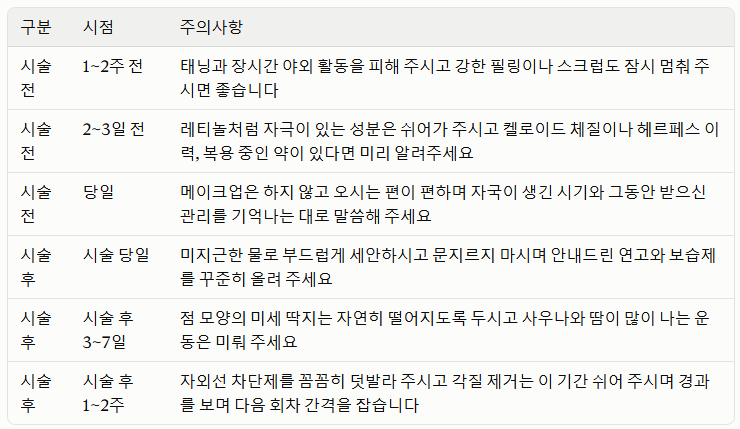
👉 Uijeongbu scar laser is a treatment that involves a recovery process, so post-treatment care and sun protection for the following days significantly affect the outcome.
⚠️ Precautions before and after Uijeongbu scar laser treatment
❓ Frequently Asked Questions (FAQ)
Q. Why doesn't Uijeongbu scar laser treat the entire surface at once?
Because if you leave untouched tissue between the columns,
the cells in those areas move from the sides to cover the surface again.
Thanks to the configuration of leaving tissue behind, you can stimulate the dermis
while keeping the recovery period within a manageable range.
Q. Why is the wavelength important in Uijeongbu scar laser?
Since skin is mostly made of water, how well the wavelength is absorbed by water
determines the reaching depth and residual heat.
2940nm is almost consumed in the surface layer and is used for precise refinement,
while 10600nm penetrates a little deeper and is used to turn on regeneration signals.
Q. Can Uijeongbu scar laser be applied to old marks?
Since hardened supporting tissue does not loosen or reorganize itself over time,
even marks that occurred a long time ago are targets for reactivating the recovery process.
However, the arrangement varies depending on the depth and type.
Q. Does Uijeongbu scar laser also treat red and brown marks?
Irregularities, redness, and brown marks have different causes.
We usually arrange the order by dividing them: fractional types for irregularities, vascular-focused items for redness,
and pigmentation-focused items for brown marks.
Q. How should I manage scabs after Uijeongbu scar laser?
Since it is a process where the solidified tissue inside the columns is pushed up and falls off,
it is better to let it pass naturally.
If you force them off, there is a possibility that marks will remain,
so we recommend letting them pass with moisturizing and sun protection.
Q. Is Uijeongbu scar laser finished in one session?
Because the area treated in one session is only a part of the whole
and it takes time for the newly created supporting tissue to settle into a stable form,
it is common to operate by building up sessions at intervals.
Uijeongbu scar laser is a treatment that views marks not as a surface problem,
but as a problem of the dermal supporting tissue.
It delivers energy by dividing the skin into very thin column units,
leaves intact tissue in between to lead the recovery,
and allows you to select the depth reached and residual heat according to the condition because the degree of water absorption varies by wavelength.
Even for marks in the same area, irregularities, redness, and brown marks have different causes,
so the order is divided.
At Cleor Clinic Uijeongbu Branch, we check these parts directly during consultation.
We also operate other items with different approaches, such as Fraxel or pore lasers,
so you can look into splitting your session configuration.
If you have been bothered by remaining marks even after they have subsided for a long time,
please feel free to talk to us.
※ This content is for general information purposes only, and changes may vary from person to person.
Please determine the exact diagnosis and whether to proceed with the procedure through consultation with a specialist.
가라앉은 뒤에도 남은 자리가 오래 신경 쓰이셨다면,
편하게 한 번 이야기 나눠 보셔도 좋겠습니다.
※ 본 내용은 일반적인 정보 제공을 위한 글이며, 개인에 따라 나타나는 변화는 달라질 수 있습니다.
정확한 진단과 시술 여부는 전문의 상담을 통해 판단하시기 바랍니다.